Skills · Safety
Man Overboard: The Figure Eight Method
How to recover a man overboard under sail with the figure eight method: beam reach away, tack, come back on a broad reach, and stop in irons next to the person in the water.
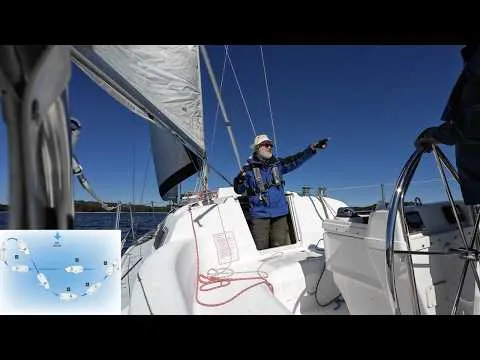 Play video: Man Overboard (MOB) Drills Using the Figure Eight Method
Watch on YouTube: Man Overboard (MOB) Drills Using the Figure Eight Method
When someone goes over the side, the figure eight method brings the boat back under sail and stops it next to them. In the video, my crew and I take turns on the Hunter 29.5 Odyssey, making passes at a throwable cushion we call "Bob." We miss some, and that is part of the lesson.
Steps
Seen from above, the boat's path looks like a figure eight, hence the name.
- Whoever sees it calls "Man overboard!" and points at the person in the water, and keeps pointing.
- Throw the person a throwable flotation device, such as a Type IV cushion or ring, right away. In our drills, the cushion was the man overboard, so we skipped this step.
- The helm turns onto a beam reach right away, with the wind on the side of the boat.
- Sail away from the person, about three or four boat lengths.
- Round up into the wind and tack.
- Bear off to a broad reach, crossing your first path, then head back up through a beam reach to a close reach as you come toward the person.
- Round up into irons, pointing straight into the wind, so the boat slows and stops right next to the person. This turn is a round up, not a tack: the bow comes up into the wind and stops there.
- Bring them aboard. It can help to work from a little farther forward, outside the coaming.
Tips
- If you miss, start the whole thing over: beam reach away, round up, tack, and come back. Missing is common. Round up too early and the boat is in irons short of the person, and the wind blows you away from them.
- In the video, my crew and I both say "tack" for the final turn into irons. That was the wrong word; it is a round up. The only tack is the one after you sail away on the beam reach.
- Going around again in the other direction, you may feel the urge to turn the stern through the wind and jibe. Both of us felt it. Tack into the wind.
- With no wind, you may not be able to reach the person at all. If they are conscious, it may be better to let them come to you.
- Stay calm. If you miss, you go around again. But don't leave the person in cold water any longer than you have to.
- Once they are aboard, get them into the cabin, get their wet clothes off, and wrap them in whatever dry material you have, even a spare sail.
- Visibility is everything. A head in the water is hard to see in even a foot or two of waves. When my crew's hat went over during a drill, we had two overboard at once. We got the cushion first, since it was better placed, then went around again for the hat, which was nearly the color of the water.
- Practice. How far the boat carries once it is in irons is something you only learn by doing it.
 Leave a tip on Ko-fi